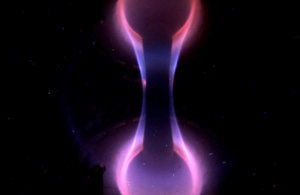
The United Kingdom Atomic Energy Authority has completed what it described as its most ambitious series of experiments to date on the MAST Upgrade fusion machine.
The fifth series of experiments, carried out at UKAEA’s Culham Campus in Oxfordshire, ran through 2025 and 2026 and produced more than 1,100 fusion plasmas. UKAEA said the work achieved the highest plasma pressure yet attained by the machine while addressing control problems considered important for future commercial fusion power.
Fusion facilities create plasma by heating, squeezing and confining hydrogen isotopes at extreme temperatures and pressures. UKAEA said higher-pressure plasma can produce more fusion power per unit volume, making it more representative of the conditions that would be needed in a commercial power plant.
A central challenge was suppressing instabilities known as Edge Localised Modes, or ELMs. These sudden bursts at the outer edge of the plasma can cause pressure loss and eject up to a tenth of the stored energy in a single event, with the potential to damage inner wall and exhaust components over time.
The MAST Upgrade team used Quasi-Continuous Exhaust mode and Resonant Magnetic Perturbations, which use coils applying 3D magnetic fields to reduce pressure at the plasma edge and help keep it stable. The team also accessed two further stable operating regimes, known as Quiescent H-mode and I-mode.
UKAEA said the programme included a world-first technique for controlling the plasma’s position by using measurements of visible light from deuterium emitted inside the machine. The results were described as one of the flagship deliveries of UKAEA’s 2026-2030 Strategy.